





BLOG
Shungite EMF Protection: How It Works, Research, and Real Use


Electromagnetic fields (EMF) are part of modern life, generated by devices such as smartphones, Wi-Fi routers, and wireless technologies.
This raises an important question: can long-term exposure to EMF affect the human body, and are there effective ways to reduce everyday exposure?
In this article, we explain what EMF is, how it may affect the body, what scientific studies suggest, and why shungite is discussed as a natural material in relation to EMF protection.
Part I. What is EMF, and how does it affect the human body?
How does shungite EMF protection work? To understand this, we first need to look at how electromagnetic fields behave.
Shungite, a natural carbon-based mineral from Karelia, is often associated with EMF protection because of two key properties. It can absorb part of the electromagnetic radiation, and it can also reflect electric and magnetic fields. These two mechanisms are the basis of most EMF shielding materials.
In simple terms, an electromagnetic wave consists of both electric and magnetic components. Because of this, effective EMF protection usually involves materials that can both absorb and reflect electromagnetic energy.
Shungite is often discussed in this context because of its unique carbon-based structure. In this article, we will explain what EMF is, how it may affect the human body, how shungite EMF protection is believed to work, what scientific studies suggest, and how this material is discussed in relation to radio frequency radiation and 5G.
Table of contents
- 1. What is EMF, and how does it affect the human body?
- 2. Part II. How does shungite EMF protection work?
- 3. Part III. Shungite EMF Protection and 5G Networks
- 4. Part IV. The use of shungite in everyday life for EMF protection
- 5. Part V. How the EMF shielding ability of shungite depends on its carbon content
What is EMF?

EMF, or electromagnetic fields, are a form of energy made up of electromagnetic waves. These waves consist of both electric and magnetic components that move through space and oscillate at the same frequency.
Where does the EMF come from?
Electromagnetic waves are produced when electric charges move, especially when that movement is accelerated. As they move, they create both electric and magnetic fields. This is why any device that runs on electricity can generate electromagnetic fields.
EMF can also be produced at a much smaller scale, including inside atoms. This happens when atomic particles or nuclei change their energy state. Examples include processes such as nuclear reactions in the Sun or in a nuclear power plant.
The main characteristics of EMF waves

- Wavelength, the distance between two nearest points of a wave that are in the same phase.
- Frequency, the number of times per second that the electric and magnetic fields change at a given point.
- Photon energy, the amount of energy carried by a single photon.
Wavelength and frequency are inversely related. A long wave has a low frequency, while a short wave has a high frequency.
What are the sources of EMF radiation?
1) Natural sources of EMF
Natural electromagnetic fields are always present around us. The most common sources include:
- The Earth’s natural electric and magnetic fields
- Radiation from the Sun, including visible light
In general, these natural fields do not harm human health. However, their intensity can sometimes change. For example, increased solar activity can disturb the Earth’s magnetic field, creating what are known as magnetic storms.
Some people, especially those with cardiovascular conditions, may be more sensitive to these changes. They can experience symptoms such as headaches or changes in heart rate during periods of high magnetic activity.
2) Artificial sources of EMF
In modern life, most EMF exposure comes from man-made devices that use electricity or transmit signals. Common sources include:
- High-voltage power lines, 50 to 60 Hz
- Monitors and video displays, 3 to 30 kHz
- Radio communication and broadcasting, 30 kHz to 3 MHz
- Industrial and medical equipment, 30 kHz to 30 MHz
- FM broadcasting, 30 to 300 MHz
- Mobile phones, Wi-Fi devices, and microwave ovens, 0.3 to 3 GHz
- Radar and satellite communication systems, 3 to 30 GHz
- Various high-frequency radio equipment, up to 300 GHz
In areas with many electronic devices, the level of artificial electromagnetic fields can be significantly higher than natural background levels.
In areas where many electrical devices are used at the same time, the level of artificial electric and magnetic fields can greatly exceed the natural background, sometimes by more than 1,000 times. In everyday life, people are most often exposed to radio frequency fields, which are part of the electromagnetic spectrum.

Is EMF dangerous?
EMF is a natural and man-made phenomenon. Most everyday exposure comes from non-ionizing radiation, which does not have enough energy to break chemical bonds.
However, researchers continue to study possible long-term and cumulative effects of electromagnetic fields on the human body.
According to the World Health Organization (WHO) , no adverse health effects from low-level long-term exposure to electromagnetic fields have been confirmed so far, although research in this area is ongoing.
What is the difference between ionizing and non-ionizing radiation?
Depending on how electromagnetic radiation interacts with matter, it is usually divided into two main types: ionizing radiation and non-ionizing radiation.
For general scientific background, the World Health Organization explains that non-ionizing radiation does not carry enough energy to ionize atoms, while ionizing radiation has sufficient energy to cause cellular damage under certain conditions.
Ionizing radiation
Ionizing radiation includes X-rays and gamma radiation. It is associated with sources such as:
- nuclear power facilities
- medical equipment such as X-ray machines and tomography scanners
This type of radiation carries enough energy to break chemical bonds in cells and other matter. Because of this, it is considered the more dangerous form of radiation and is associated with serious health risks, including radiation sickness, tumors, and genetic damage.
Non-ionizing radiation
Non-ionizing radiation does not carry enough photon energy to break cellular bonds in the same way. This is the type of electromagnetic radiation people are more commonly exposed to in daily life through electrical devices and wireless technologies.
For most people, everyday concern is focused not on ionizing radiation, but on repeated exposure to non-ionizing electromagnetic fields from modern sources such as phones, routers, and other electronic equipment.
How does EMF affect the body?
When the body is exposed to electromagnetic fields, it can absorb part of that energy. These fields may then interact with the body’s own electrical processes. Scientific research has explored how EMF may affect cell membranes, certain proteins, and the electrical activity of neurons.
For a broader scientific perspective, reviews indexed in PubMed discuss both established and debated biological effects of non-ionizing electromagnetic fields, including thermal and possible non-thermal mechanisms.
An important point is that the biological effects of EMF are not always explained only by heating. Some researchers have also examined possible non-thermal effects, which is why the topic remains important in discussions about EMF effects on the human body.
Types of body exposure to non-ionizing electromagnetic radiation
1) Disruption of communication between cells
One of the ways cells interact with each other is through ionic conduction. This process helps cells exchange nutrients and remove waste products. Some researchers suggest that low-frequency electromagnetic waves may interfere with this process.
When the body absorbs EMF, its electrical charges begin to oscillate. This can create additional internal electric and magnetic activity. As a result, the internal resistance of cells may increase, energy can be lost, and ionic conduction may be disturbed.
Some researchers have suggested that disruptions in ionic conductivity could potentially influence how nutrients and waste products move in and out of cells.
Exposure of children to low-intensity EMF
Back in the 70s, our [soviet] outstanding scientist Mikhail SHANDALA, who at one time headed the Kiev Institute of Communal Hygiene (now it works in Moscow), conducted an important study on the effect of low-intensity EMF on children. The study took place in three regions of Ukraine. For three years, they monitored children aged 6 to 14 who lived in the coverage area of the radio station.
Oleg GRIGORIEV, Director of the Center for Electromagnetic Safety, Deputy CIn the 1970s, Mikhail Shandala, a Soviet scientist and former head of the Kiev Institute of Communal Hygiene, conducted a long-term study on the effects of low-intensity EMF on children.
The radiation intensity was low, about the same as in our region of Ostankino, it was about the units of volts per meter. And we got the following: a low-intensity chronic effect on children affects their cognitive functions, their learning ability, and the formation of the functions of the central nervous system. There was also a slight tendency towards cardiovascular depression. Some early studies suggested possible effects on cognitive development, but these findings require further validation and are not considered conclusive. This is the only thing that distinguishes dangerous radiation from all other harmful factors. It is called biotropic, and if present, it interferes with the normal functioning of the body.
The study was carried out in three regions of Ukraine. Over a period of three years, researchers observed children between the ages of 6 and 14 who lived within the coverage area of a radio station. The radiation intensity was relatively low, measured in units of volts per meter.
According to the reported findings, long-term exposure to low-intensity EMF may affect children’s cognitive function, learning ability, and the development of the central nervous system. A slight tendency toward cardiovascular changes was also noted. The researchers suggested that this type of chronic exposure may interfere with the normal development and functioning of the body.
As noted by Oleg Grigoriev, Director of the Center for Electromagnetic Safety and Deputy Chairman of the Russian National Committee for Protection against Non-Ionizing Radiation, this type of biological effect has been described as biotropic, meaning that it may influence normal biological processes.
2) Disruption of the electrical balance of water molecules and proteins
In the human body, many molecules have an electrical structure that can be described in terms of a dipole moment. When the body is exposed to electromagnetic fields, some of these molecules, especially water and proteins, may begin to vibrate at the frequency of the incoming wave.
As a result, their electrical balance can change. This may lead to increased molecular movement and friction within tissues, which can contribute to heating effects.
The human body contains a large amount of water, about 60 percent in adults and up to 90 percent in newborns. Because of this, changes in the structure of intracellular and extracellular water may influence cellular processes, including metabolism and overall cell function.
For example, when electromagnetic fields interact with the body, they can affect the movement of charged particles in the blood. Some studies have explored whether EMF exposure may influence electrical activity in the body, although findings remain inconclusive. In some cases, this has been associated with minor changes in blood flow or heart rhythm.
Which organs and systems may be affected by EMF?
Over the past several decades, many researchers have studied the biological effects of electromagnetic fields on living organisms. Based on this work, several organs and systems have been identified as potentially more sensitive to EMF exposure:
- hematopoietic system
- central nervous system
- cardiovascular system
- reproductive system
- brain
- neuroendocrine system
- immune and metabolic processes
Some studies have also reported a possible association between long-term EMF exposure and increased health risks in specific occupational groups. For example, Siekierzynski H. M. and co-authors reported a higher incidence of cancer, especially leukemia, among Polish military personnel who worked with radar systems.
What frequencies are most dangerous for humans?
The biological effect of EMF radiation depends on several factors:
wavelength, or radiation frequency
mode of generation, for example continuous or pulsed exposure
conditions of exposure, including intensity, duration, and whether the exposure is constant, periodic, general, or local
When low-frequency waves affect the body over a long period of time, they may weaken ionic conduction in cells. At the same time, in general, the biological activity of electromagnetic radiation tends to decrease as wavelength increases and frequency decreases.

Higher-frequency waves carry more energy, but their biological impact depends on multiple factors such as intensity, duration, and exposure conditions. These include high-frequency and ultra-high-frequency ranges.
When the body is exposed to higher-frequency waves, the ionic conductivity of cell membranes may increase, while their capacitive resistance may decrease. As a result, electromagnetic energy can penetrate body tissues more easily and may be absorbed more intensely.
In general, the higher the frequency, the greater the amount of energy the body may absorb. This is why some researchers describe a cumulative effect of EMF exposure, especially in relation to prolonged or repeated contact.
Why phone EMF may be a concern, the cumulative effect
A mobile phone may contribute to repeated EMF exposure, especially during long daily calls. According to the source cited in this article, concern increases when phone use becomes prolonged and regular.
During a phone call, part of the electromagnetic energy is absorbed by the tissues closest to the device, especially in the head area. For this reason, people who spend a lot of time on calls often prefer to reduce direct exposure by using a headset or speaker mode.
Some people also choose to use shungite products with their phones. In this article, we will look more closely at how shungite is believed to interact with electromagnetic radiation and why it is discussed as a natural material for EMF protection.
Long phone calls inside a car may also increase exposure. The metal body of the vehicle can affect how signals behave, and while the car is moving, the phone may work harder to maintain a stable connection. As a result, the level of transmitted electromagnetic energy may increase.
Is radiation from a Wi-Fi router harmful?
A Wi-Fi router emits electromagnetic waves while transmitting data. Most Wi-Fi devices operate in frequency ranges such as 2.4 GHz and 5 to 6 GHz.
If several wireless devices are used in the same space, the overall level of electromagnetic activity in that environment may increase. As a result, some people look for ways to reduce everyday EMF exposure at home.
One of the natural materials often discussed for this purpose is shungite. For example, some people choose to include natural materials such as shungite in their environment, although this should be seen as a complementary approach rather than a primary method of exposure reduction.

Do microwave ovens emit radiation?
Yes, a microwave oven generates electromagnetic waves in order to heat food. Inside the appliance, a device called a magnetron converts electricity into high-frequency electromagnetic energy at about 2.45 GHz.
These waves cause water molecules in food to move rapidly, which creates heat through molecular friction.
Under normal conditions, the oven door is designed to keep this radiation inside. However, if the door becomes damaged or no longer seals properly, some leakage may occur over time.
To reduce unnecessary exposure, it is generally recommended not to stand too close to a microwave while it is operating. Some people also choose to place shungite EMF protection products nearby as part of their overall home EMF protection setup.
How EMF frequencies may affect the body, summary
In summary, when a person is exposed to electromagnetic fields, the body can absorb part of that energy. This may influence the body’s own electrical and magnetic activity.
Low-frequency waves are often discussed in connection with possible changes in ionic conduction between cells, which may affect normal metabolic processes. Higher-frequency waves, on the other hand, carry more energy and may be absorbed more intensely by body tissues.
Some researchers also suggest that prolonged EMF exposure may influence the behavior of water molecules and proteins in the body. Taken together, these effects are often described as going beyond simple heating alone.
How to reduce EMF exposure at home?
- Keep some distance from devices like routers and phones
- Reduce unnecessary exposure time when possible
- Use wired connections instead of wireless where practical
- Organize device placement to avoid concentrated signal zones
- Consider materials that may interact with electromagnetic fields
Part II. How does shungite EMF protection work?
Does shungite really work for EMF protection?
Shungite is studied as a natural composite material with both conductive and dielectric properties.
Some studies suggest that it may be able to absorb and scatter electromagnetic waves under certain conditions. However, the available evidence is still limited, and results can vary depending on experimental setup and measurement methods.
At the same time, its effectiveness may depend on factors such as material size, thickness, coverage area, and frequency range. For this reason, it is generally considered as part of a broader approach to managing EMF exposure rather than a standalone solution.
Various materials are studied for their ability to interact with electromagnetic waves, including those that may absorb or reflect certain frequencies. In practice, this typically includes materials that can absorb part of the wave, reflect part of it, or combine both mechanisms. These are often referred to as EMF shielding or radio-absorbing materials.
Such materials are used in protective screens, coatings, and specialized composites. Their behavior differs from that of ordinary building materials, as electromagnetic waves can pass through many surfaces and propagate over long distances.
According to current international guidelines, typical everyday exposure to non-ionizing EMF is generally considered safe within established limits.
In general, an electromagnetic wave can interact with a material in three main ways:
- it can pass through the material
- it can be absorbed by the material
- it can be reflected by the material
If a material has strong reflective or absorptive properties, it may be useful in EMF shielding materials. In many cases, protective screens are made from composites that combine more than one function. Shungite is of particular interest because it is discussed as a natural material that may combine several useful properties at once.
How do EMF shielding materials work?
Materials used for EMF protection are often divided into several types:
Reflective materials
These materials reflect part of the electromagnetic wave. This helps reduce the intensity of the incoming energy. The effect is often connected with multiple re-reflections from conductive structures inside the material, such as flakes or nanoparticles.
Absorbing materials
These materials absorb electromagnetic radiation. Inside the material, part of the wave energy is converted into heat through dielectric and magnetic losses.
Combined materials
These materials combine both reflective and absorptive properties. This makes them especially interesting for practical electromagnetic radiation protection.
Interference-based materials
In these materials, the electric and magnetic fields are weakened through the interaction of waves with different phases.
How does shungite absorb EMF radiation?

Shungite stone is often linked to the natural structure of this rare stone from Karelia. This region is known as the world’s only major deposit of shungite, which makes the mineral especially unique.
One reason shungite is discussed in relation to EMF protection is its complex internal structure. It consists of a quartz matrix, made of silicon dioxide, with scattered carbon particles inside it. This carbon structure includes fullerene-like formations and other nanoparticles. The mineral may also contain small metal inclusions within the quartz framework.
Because of this combination of conductive and dielectric components, shungite is often described as a natural composite material with the ability to absorb, scatter, and partly reflect electromagnetic waves. This is one of the main reasons why shungite EMF protection continues to attract scientific and practical interest.
If you would like to explore this mineral in more detail, you can also read our separate article about shungite and its natural properties.

The absorption of electromagnetic radiation is commonly explained by the formation of eddy currents in conductive structures and their scattering within a dielectric material. This is one of the reasons shungite is discussed as a natural composite for EMF protection, since it combines a carbon-based conductive phase with a quartz dielectric matrix [6].
Shungite EMF Protection: Research
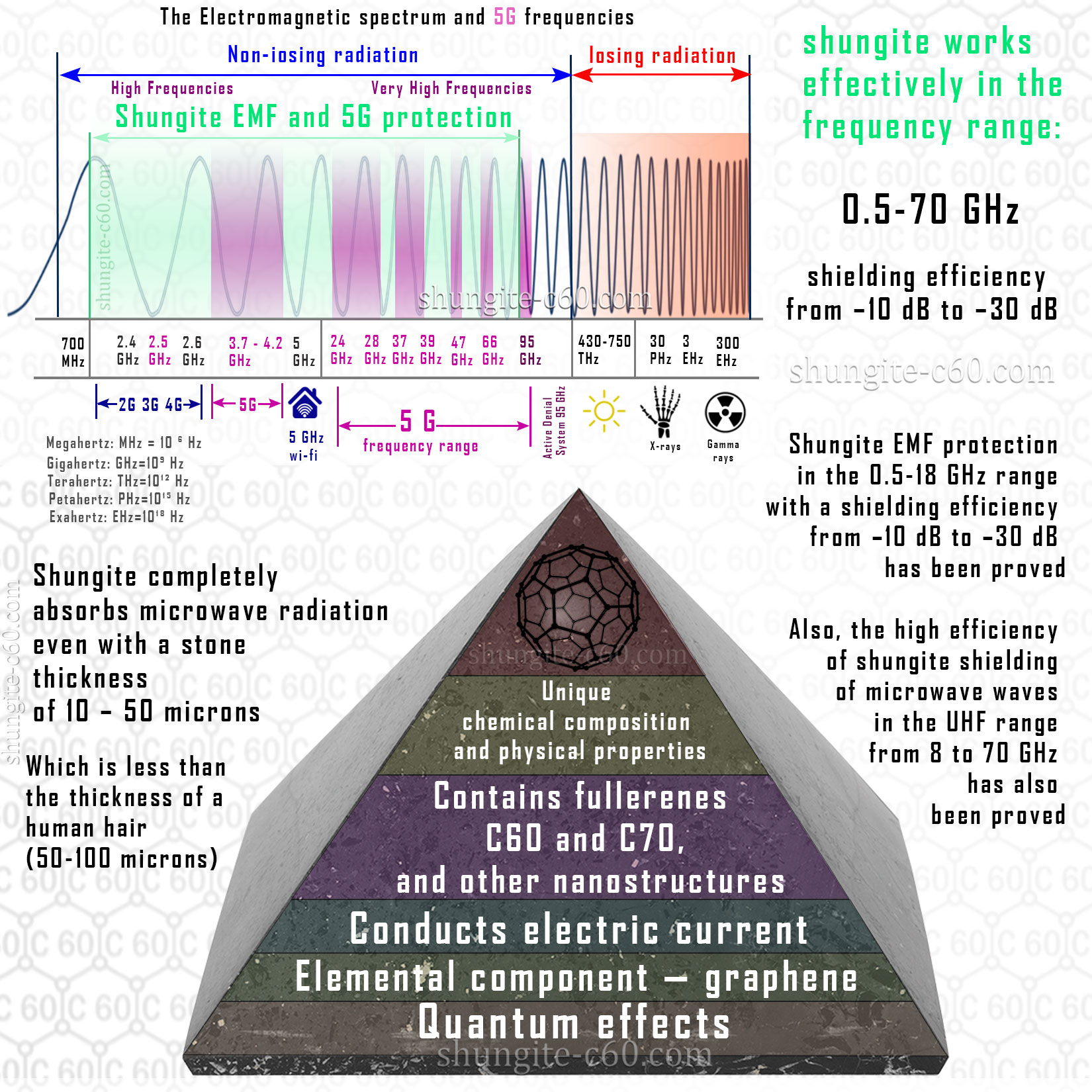
The protective properties of shungite from Karelia have been examined in a number of scientific studies. In this research, shungite properties were measured using specialized scientific equipment. Studies of type III shungite were carried out in the UHF range from 8 to 70 GHz [19].
According to these findings, shungite showed a high level of electromagnetic shielding performance. Some studies reported that this material was able to absorb microwave radiation very effectively even at thicknesses of only tens or hundreds of microns [7, 8, 9, 10, 11].
The shielding properties of shungite are also reflected in patents registered in both the Russian Federation and the United States, including Russian Federation Patent No. 2255866, US Pat. No. 6818821, and US Pat. No. 6937184.
Some authors also note that the shielding ability of shungite may increase as the frequency of electromagnetic oscillations rises, while the effectiveness of some metal structures may decrease at frequencies above 5 GHz [12].
As one example, the research of V. V. Rodionov, Candidate of Physical and Mathematical Sciences, reported that natural type III shungite absorbed microwave radiation in the 12.6 to 40 GHz range at levels from 9.5 to 44.5 dB [13].

Many studies have examined protective composites based on shungite and their interaction with electromagnetic waves [14, 15, 16, 17]. Based on these findings, shungite EMF protection in the 0.5 to 18 GHz range has been reported with shielding efficiency from –10 dB to –30 dB [18]. High shielding efficiency in the UHF range from 8 to 70 GHz has also been reported for shungite in relation to microwave radiation [19].
Conclusions from research on the EMF protective properties
In summary, the available research suggests that these properties is closely related to the stone’s complex internal structure. One proposed mechanism is an increase in dielectric loss, which helps weaken the electromagnetic wave inside the material. Another is the scattering of electromagnetic energy across carbon structures and within the silicon-based framework.
Researchers describe several structural features of shungite as especially important:
- high initial conductivity [19]
- a developed nanoscale structure and natural porosity
- carbon in specific allotropic forms, including nanoparticles such as C60 fullerenes, C70 fullerenes, fullerites, monocrystalline graphite, and graphene [20]
- a silicon matrix with naturally occurring dielectric components

In another study [31], Victor G. Zavodinsky and Alexander P. Kuz’menko used quantum-mechanical calculations to examine the electronic structure of C60 fullerene fragments in contact with silicon dioxide particles, or quartz.
Their results suggested that such complexes may form regions with metallic properties at the Fermi level, located next to dielectric regions. This combination of conductive and dielectric areas may help explain the absorption and dissipation of microwave radiation. According to this interpretation, similar mechanisms may also be present in natural shungite minerals.
Shungite EMF Protection: the structural level
The reflection and scattering of electromagnetic radiation in shungite are believed to take place at the nanoscale level of its structure. As an EMF wave passes through the stone, part of its energy may be weakened through dielectric losses in the silicon-based framework. At the same time, layered carbon nanoparticles, including fullerene-like structures and fullerites, may contribute to the absorption of electric and magnetic components through eddy current effects.
Multiple internal re-reflections may also occur within the lamellar carbon structures. As a result, microwave energy can be dissipated more effectively, with part of that energy converted into heat after repeated interactions inside the material.

This suggests that the absorption mechanisms in shungite are closely connected to its internal structure. C60 fullerenes and other nanocarbon inclusions are often discussed in terms of nanoscale electromagnetic behavior, which differs from classical electromagnetic models. Based on this, several studies describe shungite as a material capable of absorbing, reflecting, and scattering electromagnetic waves within its structure [22, 23, 24].
In this sense, this black stone is generally explained as a combination of absorption, reflection, and internal scattering.
Part III. Shungite EMF Protection and 5G Networks

What is 5G radio frequency, and how is it different from other EMF radiation?
EMF radiation consists of electromagnetic waves that together form an electromagnetic field. These waves exist across a wide spectrum, with different wavelengths and frequencies. In this sense, 5G is also part of the electromagnetic spectrum, but within a specific frequency range used for mobile communication.
The term 5G refers to the fifth generation of mobile network technology. Compared with 4G, it is designed to provide higher speed, lower latency, and greater network capacity. In many cases, the transition from 4G to 5G begins by using parts of the existing 4G infrastructure through frequency refarming.
| Parameters | 4G | 5G |
|---|---|---|
| Peak download speed | 1 Gigabit/sec | 20 Gigabit/sec |
| Download speed for users | 10 Megabit/sec | 100 Megabit/sec |
| Delay | 10 milliseconds | 4 milliseconds (1 milliseconds for URLLC) |
| Maximum travel speed without signal loss | 350 km/h | 500 km/h |
| Connection density | 100 000 devices/km2 | 1 000 000 devices/km2 |
| Traffic per unit area | 10 Mbps/m2 | 10 mbps/m2 |
What frequencies are used for 5G?
5G uses two main frequency ranges of electromagnetic waves:
1) Frequency Range 1, FR1
This range includes the more traditional sub-6 GHz frequencies, such as 2.5 GHz, 3.5 GHz, and 3.7 to 4.2 GHz. These frequencies are generally used to carry data over longer distances and to provide broader coverage.
2) Frequency Range 2 (FR2)
This is the higher-frequency range, often called the millimeter wave band. It is designed for fast data transmission over shorter distances. One of the main differences between 4G and 5G is the introduction of this second range.
FR2 typically begins around 24 GHz and may extend to 50 GHz or higher, depending on the country and the operator. In the United States, for example, commonly discussed bands include 24 GHz, 28 GHz, 37 GHz, 39 GHz, and 47 GHz. Frequencies above 95 GHz are also being considered [25].
5G concerns, a growing number of non-ionizing EMF transmitters and receivers
One of the main concerns often raised about 5G is not only the frequency range itself, but also the large number of transmitters needed to support it. In particular, Frequency Range 2, or FR2, uses high-frequency electromagnetic waves with very short wavelengths measured in millimeters.
These waves are effective for transferring large amounts of data over short distances. At the same time, their ability to pass through obstacles is lower, so the signal weakens more quickly.
What are 5G small cells?
Because the higher-frequency 5G range is more sensitive to interference and environmental obstacles, each base station covers a smaller area. For this reason, 5G networks require a denser infrastructure made up of many smaller transmitters, often called small cells.
In urban environments, these small cells may be placed on lighting poles, building walls, transport stops, and other everyday structures. In some cases, they may even be integrated into objects such as advertising panels or street equipment.
In practical terms, one of the defining features of 5G is the introduction of this higher-frequency millimeter-wave range in order to achieve greater speed and higher data capacity.
Why is 5G technology a concern for some people?
- One of the main concerns about 5G is that it uses a large number of transmitters that emit high-frequency electromagnetic waves.
- Higher-frequency waves are often discussed as more biologically active because they carry more energy. In addition, the dense network of transmitters and receivers may increase the overall level of electromagnetic activity in the surrounding environment.
- Because many 5G signals can exist in the same area, their combined presence may lead to greater overall exposure. Some researchers and observers suggest that this may increase the cumulative effect of non-ionizing electromagnetic radiation on the human body.
- For this reason, 5G is often discussed in connection with possible biological effects related to prolonged or repeated EMF exposure.
At the same time, international exposure guidelines such as those from the International Commission on Non-Ionizing Radiation Protection (ICNIRP) state that technologies including 5G, Wi-Fi, Bluetooth, and mobile networks are considered safe when exposure remains within established limits.
How to protect yourself from 5G EMF radiation

Because 5G networks rely on a large number of nearby transmitters, traditional ways of reducing exposure, such as increasing distance or limiting time near the source, may become more difficult in some environments. This is one of the reasons why 5G technology continues to be widely discussed.
At the same time, 5G waves are still part of the broader electromagnetic spectrum. This means that materials used for EMF protection are also discussed in relation to 5G exposure.
Among these materials, shungite is often mentioned because of its natural composite structure and its reported EMF shielding properties. In scientific and technical literature, shungite-based materials have been studied as radio-absorbing composites for non-ionizing electromagnetic radiation.
For this reason, shungite EMF protection is sometimes considered as part of a broader approach to reducing everyday exposure to electromagnetic fields, including those associated with 5G frequencies.
At the same time, international health organizations state that current exposure levels from 5G technology remain within established safety limits.
Part IV. The use of shungite in everyday life for EMF protection
Shungite products and applications
Many research institutes and organizations study electromagnetic fields and develop materials designed to reduce EMF exposure [26]. These materials are typically radio-absorbing composites with complex internal structures. However, their production can be expensive, which has led to interest in more affordable natural alternatives.
In this context, shungite from Karelia is often discussed as a practical and cost-effective material for EMF shielding. Because of its structure, it is used as a base for different types of protective materials.
For example, shungite-based materials are used in:
- shielding paints made with shungite powder [27]
- finishing materials such as tiles and flooring [28]
- cement mixtures with shungite inclusions
- building panels made from shungite-treated composite boards
- anechoic chambers for scientific research
- certain industrial and military applications
- specialized treatment and shielding rooms
In such materials, the main shielding principle is the redirection of electromagnetic energy through reflection from uneven internal surfaces, combined with the absorption of waves within the shungite-based structure.
Scientific patents for shungite-based EMF shielding materials
Various organizations have studied the protective properties of shungite and developed materials based on this mineral for EMF shielding. In a number of cases, these technologies were also patented. In general, a patent is granted only when an invention is considered novel, technically meaningful, and suitable for practical industrial use.
Below are several examples of patents related to shungite-based electromagnetic shielding materials and protective applications:
- Electromagnetic wave absorption material and associated device, US Pat. No. 6818821, 2004 [32]
- A protective shield against electromagnetic radiation and a method of manufacture, Patent No. 2234176, 2002, Scientific and Technical Innovation Enterprise “Girokont”
- Building material for shielding premises, Patent No. 2388715, 2010, ALFAPOL LLC. This dry mortar was designed to protect equipment and people in medical, industrial, scientific, administrative, and residential spaces
- Dry composition based on shungite for producing materials with a unique combination of properties, RU 2540747, National Research Technological University MISiS
- Composite material based on shungite and a method for its production, RU 2405749. This patent describes facing tiles with shielding and additional functional properties
- Wood-chip board with shungite powder, Utility Model Patent RU 137500 U1, Russia, 2013, Petrozavodsk State University
- Device for protection against energy impact, Patent No. 2255866, 2009, OOO “Multitekhnologii”. This device was designed to reduce exposure to radio emissions from household appliances and mobile phones
Medical and military applications of shungite-based EMF shielding materials
The protective properties of shungite have also been applied in specialized medical and technical environments. For example, shungite-based materials have been used in treatment rooms designed to shield electric and magnetic fields. Some sources describe such spaces as supportive for overall physiological stability, including cardiovascular comfort.
Shungite EMF protection materials have also been used in the construction of anechoic chambers. These are specialized rooms designed to absorb both electromagnetic waves and sound waves, creating an environment without echo or outside signal interference. Such chambers can be used for scientific measurements, acoustic recording, and the testing of high-power radar systems.
One example mentioned in the literature is a large anechoic chamber built for the Russian defense concern Almaz-Antey. According to the source, the shielding frame of this chamber was made using shungite-based material.
More broadly, type III shungite radio-absorbing materials have been used in construction and interior finishing to improve electromagnetic safety in residential and workplace environments near sources of electromagnetic radiation. They have also been discussed in relation to shielding from medical X-ray equipment [30]. This shows that shungite-based materials have attracted interest not only for household use, but also for medical, technical, and military applications.
Shungite EMF Protection: Benefits of a Natural Material
One of the main advantages of shungite is that its EMF shielding properties have been studied even at very small material thicknesses. As mentioned above, some research examined thin shungite plates with a thickness of only 10 to 50 microns, which is even less than the thickness of a human hair.
According to the studies cited in this article, shungite demonstrated a high level of absorption across both lower and higher frequency ranges, in some cases reaching 40 dB or more. This creates interesting possibilities for the use of shungite powder in shielding paints and other composite materials.
How is shungite used in everyday life?
For everyday use, shungite products such as pyramids, spheres, and cubes are often chosen as part of a home EMF protection setup.

Part V. How the EMF shielding ability of shungite depends on its carbon content

Elite type I versus classic black type III shungite
Shungite can be classified by its carbon content. For example, researcher P. A. Borisov distinguishes five main types: type I, also called elite shungite, with 75 to 98 percent carbon, type II with 35 to 75 percent, type III with 20 to 35 percent, type IV with 10 to 20 percent, and type V with less than 10 percent carbon.
According to multiple studies, type III shungite, with a carbon content of 20 to 35 percent, has shown high efficiency in absorbing and reflecting electromagnetic radiation, including in comparison with material that contains a much higher percentage of carbon. At the same time, type III shungite has been studied more extensively in relation to EMF shielding properties. This is one reason it is widely discussed as a practical material for EMF protection across a broad range of non-ionizing frequencies.
Scientific research on shungite powder and EMF shielding

As one example, V. V. Rodionov [10] carried out a detailed study of the microwave properties of shungite from the Zazhoginskoye deposit in the Republic of Karelia, Russia. In this work, the sample had a carbon content of 33.62 percent.
The researcher used sample No. 1 in the form of powder taken from the Zazhoginskoye deposit with its natural carbon content of 33.62 percent. Sample No. 2 was prepared from the same material, but with all non-carbon components removed, which increased the carbon concentration to 95 to 98 percent.

Shungite EMF Protection: Results of the study
The research found that the carbon in shungite from the Zazhogino deposit is identical to the carbon found in elite type I material, also known as anthraxolite, with a carbon content above 98 percent [10, p. 85].
The scientists noted that sample No. 1, with a carbon content of 33.62 percent, absorbed microwave radiation very effectively. At the same time, the difference between the two samples was relatively small and appeared mainly in the form of oscillation patterns.
The high level of microwave absorption in the natural sample was associated with its relatively low electrical conductivity, about 1 S/m. This, in turn, increased dielectric loss because the material still contained non-conductive quartz [10, p. 117].
In sample No. 2, with a carbon content of 95 to 98 percent, the researchers observed a slight increase in the reflection of EMF waves. Overall, both samples absorbed electromagnetic waves through a combination of multiple reflections and absorption within layered carbon structures.

In conclusion, no significant difference was observed in the combined processes of absorption and reflection of EMF waves between samples No. 1 and No. 2.
For this reason, shungite from the Zazhoginskoye deposit in Karelia, the only known large natural deposit of this material, is widely used in industrial applications to develop materials for EMF shielding.
How to use shungite for EMF protection
In everyday life, shungite is most often used near common sources of electromagnetic fields, especially in places where people spend a lot of time. These may include Wi-Fi routers, home workspaces, and areas near frequently used electronic devices.
For example, some people place a shungite pyramid, sphere, or cube near a router or computer as part of their home EMF protection setup. Others prefer smaller shungite products for personal use, such as phone plates or pendants.
In our store, we offer genuine shungite from Karelia, including material from the Zazhoginskoye deposit. We can confirm the authenticity of our stone with certificates, and we also pay special attention to product quality so that customers can avoid imitations and fake materials.

Conclusion
In summary, this article has explored the main question of shungite EMF protection and explained how shungite is believed to interact with electromagnetic waves. We also looked at scientific studies that examined its properties, including its potential use in EMF shielding materials and industrial applications.
Overall, shungite is of particular interest because of its complex natural structure and its ability to combine conductive and dielectric properties in one material. This combination is often discussed as a key factor in its interaction with electromagnetic radiation.
At the same time, it is important to understand that the effectiveness of any EMF protection depends on many factors, including the amount of material and the area it covers. For this reason, small everyday items made from shungite are usually considered as part of a broader approach to reducing EMF exposure.
Beyond EMF-related applications, shungite also attracts attention due to its unique carbon structure and the presence of fullerene-like formations.
Understanding EMF and how materials interact with it allows you to make more informed decisions about your environment.
If you found this article helpful, we would be glad if you shared it with others and linked to our website.
FAQ About Shungite EMF Protection
Clear and practical answers to the most important questions about shungite, EMF protection, Wi-Fi, phones, 5G, and realistic everyday use.
About this article
This article reflects years of practical experience working with natural shungite materials and studying available scientific literature on EMF and material properties. This article is based on publicly available scientific research and materials related to electromagnetic fields and material science. It is intended for informational and educational purposes only and does not constitute medical advice.
About the author
This article is based on scientific literature and practical experience working with natural carbon-based materials such as shungite.
These scientific resources were used to create this article:
- [1] Bernhardt J.H., 1979, 1984
- [2] – Works of Soviet authors Drochigina NA, Sadchikova MN, 1964; Konchalovskaya N.M. et al., 1964; Sokolov V.V. et al., 1964; Belova S.F., 1968; Vermel A.E., Sadchikova N.M., 1983, etc., V.V. Antipov et al., 1980. Monographs and reviews Gordon ZV, 1966; thematic collections of Scientific Research Institute G.T. and P.Z. of the USSR Academy of Medical Sciences 1960, 1964, 1968, 1972. R.A. Williams and Th.S. Webb (1980). Kallen В. et al., 1982-Imerov N.F., Suvorov G.A. “Physical factors of the industrial and natural environment. Hygienic Assessment and Control. – Moscow Medicine, 2003
- [3] Siekierzynski H. M., Czerski P. et al., 1974, S. Hamburger et al., 1983, Szmigielski S., Pool R., 1990.
- [4] Interview Oleg GRIGORIEV, Director of the Center for Electromagnetic Safety, Deputy Chairman of the Russian National Committee for Protection against Non-Ionizing Radiation, and member of the Scientific Advisory Committee of the WHO International Electromagnetic Project.
- [5] Jushkin N. P. Globular supramolecular structure data scanning tunneling microscopy Reports. Acad. Science USSR. 1994. Vol. 337, № 6. P. 800–803 [in Russian].
- [6] VI All-Russian conference on nanomaterials with elements of a scientific school for young people. Moscow. From 22 to November 25, 2016, The Collection of Materials, page 413
- [7] Moshnikov I.A., Kovalevsky V.V., Lazareva T.N., Petrov A.V. Using c60 Russian emf protection rocks to create radio-shielding composite materials. Proceedings of the meeting “Geodynamics, magmatism, sediment genesis and minerality of north-west Russia. Petrozavodsk Institute of Geology, KarRC RAS. 2007.S. 272-274.
- [8] Lynkov L.M., Mahmud M.Sh., Krishtopova E.A. Screens of electromagnetic radiation based on powder. Bulletin of Polotsk State University. Series C. Fundamental Sciences. Novopolotsk PSU. 2012. No. 4. S.103-108.
- [9] Sokolov V.A., Kalinin Yu.K., Dyukkiev E.F. (ed.). Shungite emf protection stone is a new carbonaceous raw material. Petrozavodsk Karelia. 1984
- [10] Rodionov V.V. Mechanisms of interaction of microwave radiation with nanostructured carbon-containing materials. Dissertation for the degree of Ph.D. Kursk. 2014.
- [11] Golovanov O.A., Makeeva G.S., Rinkevich A.B. Interaction of electromagnetic waves with periodic lattices of micro- and nanoribbons of graphene in the terahertz range. ZhTF. 2016.V.86. # 2. Pp. 119-126.
- [12] D.V. Tyulnin. TO THE QUESTION OF PRIORITY AREAS PRACTICAL USE OF RAW Rock MATERIALS Seminar No. 7. 2010
- [13] V.V. Rodionov, Mechanisms of interaction of microwave radiation with nanostructured carbon-containing materials, dissertation for the degree of candidate of physical and mathematical sciences Kursk, 2015.
- [14] Mechanisms of microwave absorption in carbon compounds from shungite rock S.G. Emelyanov, A.P. Kuzmenko, V.V. Rodionov, M.B. Dobromyslov Journal of Nano- and Electronic Physics. 2013. Vol. 5, N 4. Р. 04023-1 – 04023-3.
- [15] Carbon nanostructured formations from Russian rock A.P. Kuzmenko, V.M. Emelyanov, V.E. Dreizin, S.A. Efanov, V.V. Rodionov News of the South-West State University. 2012.Vol. 2, No. 41, part 1. S. 97-102.
- [16] Influence of structural features and physico-chemical properties of metal-carbon nanocomposites with ferromagnetic metal inclusions on microwave radiation A.P. Kuzmenko, L.V. Kozhitov, D.G. Muratov, V.V. Rodionov, A.V. Popkova, E.V. Yaku-shko, M.B. Dobromyslov Journal of Nano- and Electronic Physics. 2017. Vol. 6, N 3. P. 03024-1 – 03024- 5.
- [17] Graphene-based microwave absorb-ing composites A review and prospective F. Meng, H. Wang, F. Huang, Y. Guo, Z. Wang, D. Hui, Z. Zhou Composites Part B Engineering. 2018. Vol. 137. Р. 260-277.
- [18] Abdulhadi H. D. A., Belousova E. S., Prudnik A. M., Lynkou L. M. Mechanical and electromagnetic properties of shields on the base of needle-punched material with conductive and dielectric coatings. Proceedings of the National Academy of Sciences of Belarus.Physical-technical series, 2019, vol. 64, no. 1, pp. 44–50.
- [19] A model representation of graphene-containing rock’s microstructure, conductivity, and microwave properties. Journal of Radio Electronics. 2017. No. 9.
- [20] Golubev E.A. AFM study of aggregates of carbon nanoparticles from aqueous colloidal solutions of stones and fullerenes E. A. Golubev, N. N. Rozhkova, V. N. Filippov Surface. – 2007. – No. 10. – S. 47-52.
- [21] Yushkin N.P. Globular supramolecular structure of Karelian rock data of scanning tunneling microscopy Dokad Academy of Sciences USSR. 1994. T. 337. No. 6. P. 800–803.
- [22] Emelyanov, S.G. Mechanisms of microwave absorption in carbon compounds [text] S.G. Emelyanov, A.P. Kuzmenko, V.V. Rodionov, M.B. Dobromyslov Journal of Nano- and Electronic Physics. — 2013. — Vol. 5., № 4. — P. 04023-1 – 04023-3.
- [23] Kuzmenko, A.P. Microwave absorption mechanisms in carbon compounds [text] A. P. Kuzmenko, V.V. Rodionov, S. G. Emelyanov Physics and technology of nanomaterials and structures collection of scientific articles of the International Scientific and Practical Conference.– Kursk, 2013.– P. 23 – 25.
- [24] Kuzmenko, A.P. Shielding of microwave radiation with carbon nanomaterials [text] A.P. Kuzmenko, V.V. Rodionov Information-measuring diagnostic and control systems. Diagnostics – 2013 Sat. materials III Intern. Scientific and technical Conf. – Kursk, 2013. – S. 128 – 135.
- [26] The International Electrotechnical Commission (IEC) and the Special International Committee on Radio Interference (CISPR) conducted extensive research to create a regulatory framework in EMC, means and materials created to protect against electromagnetic disturbances. [25] The Federal Communications Commission fcc.gov5G.
- [27] Electromagnetic absorbers based on fire-resistant paints with powder filler. D.N. Lisovsky, M.Sh. Mahmud, G.A. Vlasova, T.A. Pulko. Belarusian State University of Informatics and Radioelectronics. P. Brovki 6, Minsk, 220013, Belarus Received March 27, 2012.
- [28] Decorating material based on rock from Russia for protection of biological objects from electromagnetic fields M.Sh. Mahmud, E.S. Belousova, A.A. Kazeka, A. M. Pudnik Belarusian State University of Informatics and Radioelectronics. P. Brovki, 6, Minsk, 220013, Belarus. Received October 11, 2014.
- [29] Nanostructured screens of electromagnetic radiation, E.S. Belousova abstract for the degree of Candidate of Technical Sciences, Mink 2015, Belarusian State University of Informatics and Radioelectronics.
- [30] PROTECTION OF RESIDENTIAL SPACES FROM ELECTROMAGNETIC FIELDS AND IONIZING RADIATION. Article in the collection CONSTRUCTION-2014: Modern Problems of Industrial and Civil Construction. FGBOU VPO Rostov State University of Civil Engineering (Rostov-on-Don), 2014. Most importantly, the advantages of natural stone are that the shungite EMF protection properties of the rock manifest even at the smallest mineral thickness.
- [31] ELECTRONIC STRUCTURE OF COMPLEXES CONSISTED OF FULLERENES, THEIR FRAGMENTS, AND SILICON DIOXIDE NANOPARTICLES. Zavodinsky Victor G., Institute for Materials Science of the Russian Academy of Sciences, Khabarovsk, Russia. Kuz’menko Alexander P., South-West State University, Kursk, Russia
- [32] Electromagnetic wave absorption material and an associated device.


